
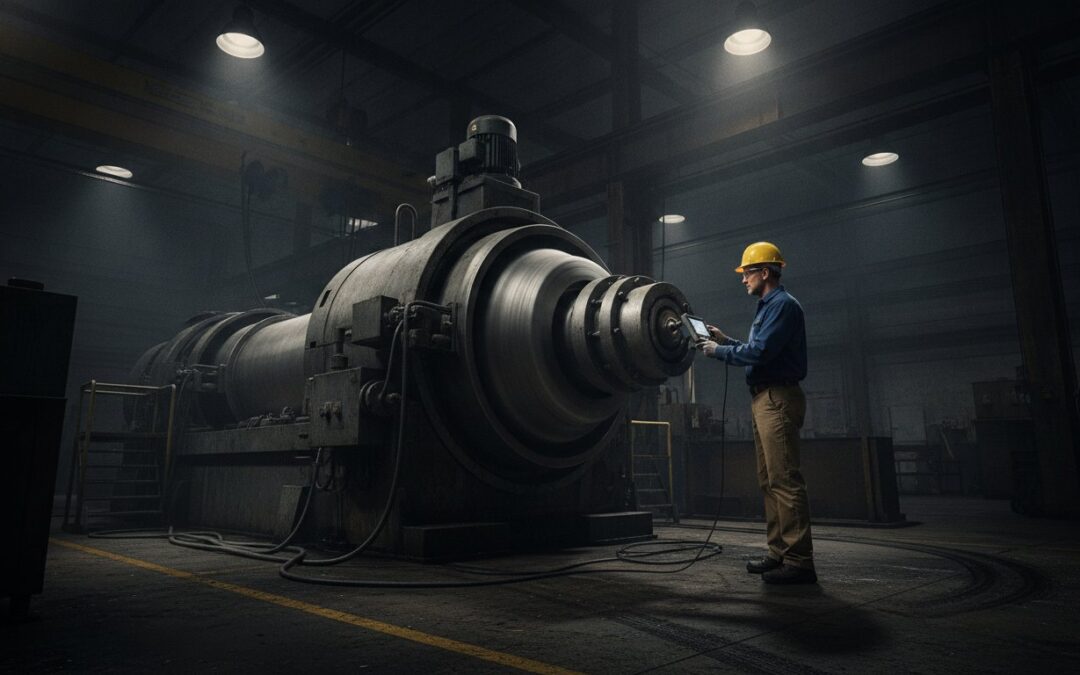
A single gram of imbalance at 3,000 RPM isn’t just a nuisance; it’s a kinetic bomb waiting to tear through your housing and take your production line with it. You’ve likely spent enough time around rotating equipment to know that when the floor starts humming, your bearings are already on borrowed time. It’s a high-stakes environment where “close enough” is a recipe for a middle-of-the-night emergency repair. This guide provides the precision engineering requirements for high-speed centrifuge balancing to help you eliminate vibration, protect your hardware, and prevent catastrophic failure.
We agree that unplanned downtime is the enemy of any profitable operation. That’s why we’re going to dive into the technical details of how to keep your machines within the vibration limits specified by ISO 20816-3. You’ll learn the critical differences between static and dynamic balancing, identify exactly when a shop-balance is required over a field-balance, and see how to establish a predictive maintenance routine that stops problems before they start. It’s about moving from reactive fixes to total asset control and ensuring your high-mass components stay exactly where they belong.
Key Takeaways
- Learn how minor mass imbalances translate into thousands of pounds of destructive force when rotating at industrial speeds.
- Understand the current ISO 21940-11 standards and why G2.5 is the required balance grade for high-speed rotating assets.
- Identify the limitations of field trim balancing and when a full shop-based dynamic balance is necessary to restore equipment to factory specs.
- Discover how professional high-speed centrifuge balancing protects your bearings and prevents the high costs associated with catastrophic housing failure.
- Recognize the early signs of erosive wear and uneven process build-up that lead to vibration before they trigger an emergency shutdown.
The Physics of High-Speed Industrial Centrifuge Imbalance
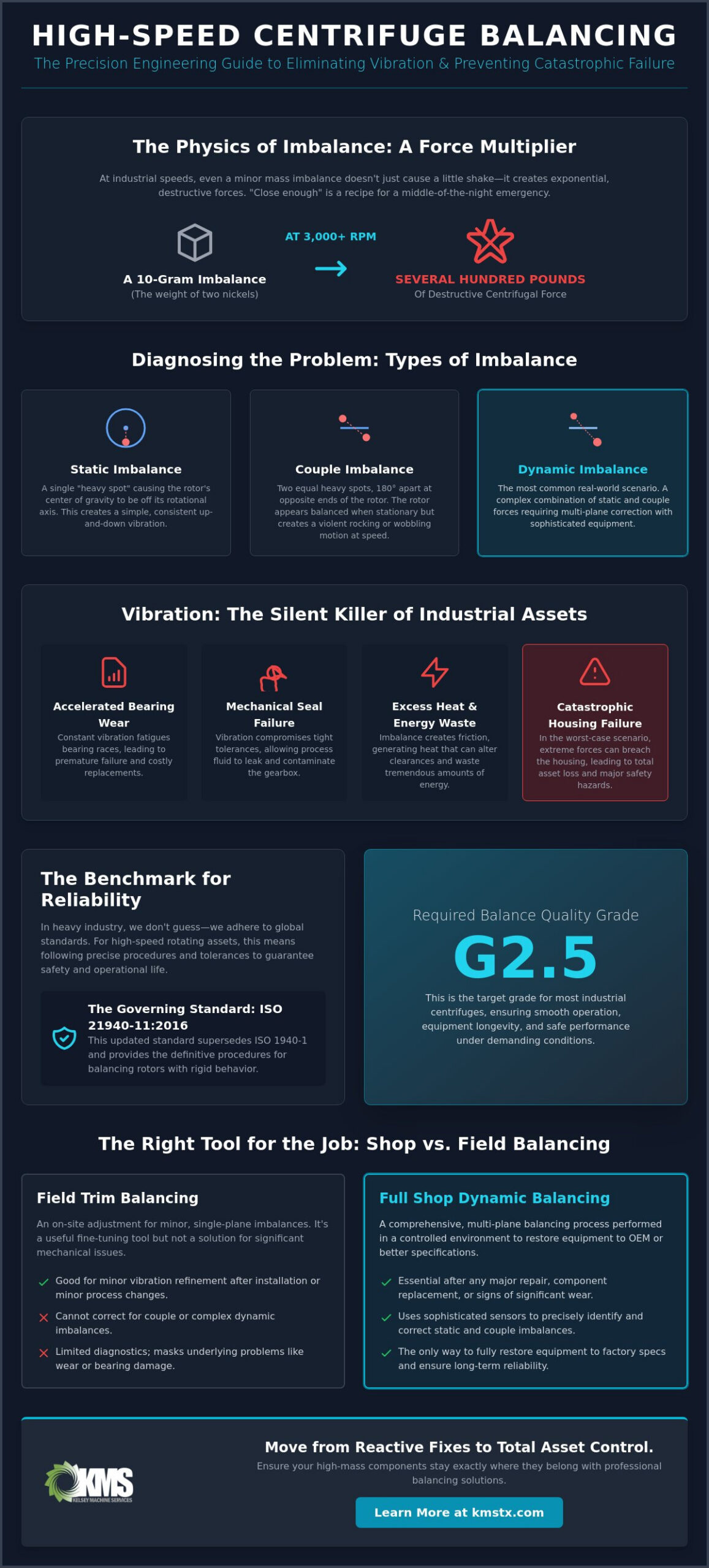
High-speed centrifuges operate on the razor’s edge of mechanical physics. When a rotor spins at 3,000 RPM or higher, the centrifugal force isn’t just a theoretical number on a spec sheet; it’s a massive physical reality that dictates the life of your machine. The relationship between mass, radius, and the square of angular velocity means that even a tiny deviation in weight distribution creates exponential force. Understanding The Physics of Balancing is essential because it reveals how a 10-gram imbalance can turn into several hundred pounds of centrifugal load at operating speed. It’s why high-speed centrifuge balancing isn’t just a maintenance task; it’s a critical safety requirement.
In a perfect world, the center of gravity (CG) would align perfectly with the geometric center of the rotor shaft. In reality, manufacturing tolerances, material density variations, or uneven wear from abrasive slurries shift that CG. When these centers don’t line up, the rotor wants to spin around its mass center, but the bearings force it to spin around the shaft center. This conflict generates the vibration you feel in the floor. At low speeds, these defects might be invisible, but once you ramp up to operational RPM, the forces amplify until they become destructive.
To better understand this concept, watch this helpful video:
Static vs. Dynamic Imbalance
Imbalance usually presents in three distinct ways, and knowing which one you’re dealing with helps determine the repair path. Static imbalance is the simplest form, often called a “heavy spot.” If you put the rotor on knife edges, it would always roll until the heavy spot is at the bottom. During operation, this causes a consistent vertical vibration. Couple imbalance is more complex; it’s when two equal heavy spots sit on opposite ends of the rotor, 180 degrees apart. It looks balanced when stationary, but it creates a violent rocking motion once it’s up to speed. Dynamic imbalance is the real-world headache that most shops face. It’s a combination of both static and couple forces, and it’s the primary reason why precision high-speed centrifuge balancing requires sophisticated diagnostic equipment to resolve.
The Impact on Rotating Equipment Longevity
Vibration is the silent killer of industrial assets. It’s not just the noise or the rattling bolts. Every vibration cycle puts stress on the bearing races and the mechanical seals. This leads to accelerated wear and, eventually, seal failure that can leak process fluid into the gearbox. Unbalanced systems also generate excess heat through friction. This thermal expansion can change the tight clearances between the scroll and the bowl, leading to even more vibration or “clashing.” At 3,000+ RPM, a major imbalance doesn’t just wear things out; it risks a catastrophic housing breach that can lead to total asset loss and serious safety concerns for your crew.
Precision Balancing Standards and Tolerances
In the world of heavy industry, we don’t just “eyeball” a fix. We rely on established benchmarks to ensure equipment safety and longevity. For years, ISO 1940-1 was the global benchmark, but it has been superseded by ISO 21940-11:2016. This updated standard provides the procedures and tolerances for rotors with rigid behavior, and it’s the foundation for any serious high-speed centrifuge balancing protocol. When we discuss G-grades, we’re talking about the balance quality. For most industrial centrifuges, G2.5 is the target. If you’re working with critical assets in the oil and gas or petrochemical sectors, you’ll likely encounter API 617 or API 610 standards, which often demand even more stringent limits to ensure the machine survives years of continuous duty.
Interpreting vibration data is where the real shop expertise comes into play. You’ll usually see measurements in inches per second (ips) for velocity or mils for displacement. Velocity is generally the best indicator of a machine’s overall health because it measures the destructive energy of the vibration. Displacement, on the other hand, tells you exactly how much the shaft is physically moving, which is critical for checking internal clearances. According to ISO 20816-3, a vibration level of 2.8 mm/s or less is the ideal target after balancing. Once you hit 4.5 mm/s, you’re in the alert zone, and anything above 7.1 mm/s requires immediate action to prevent a total failure.
Calculating Balance Quality Requirements
Vibration Monitoring as a Diagnostic Tool
Modern maintenance teams utilize accelerometers to identify frequency peaks and catch problems early. A strong peak at exactly 1x the running speed is a classic sign of imbalance. However, if you’re seeing peaks at 2x or 3x, you’re likely dealing with misalignment or mechanical looseness rather than a weight issue. By setting your alarm and trip setpoints to match ISO standards, you ensure the centrifuge shuts down automatically before an imbalance can destroy the bearings or breach the housing. It’s about using data to move from reactive repairs to a controlled, predictive maintenance schedule.
Dynamic Balancing: Shop Services vs. Field Trim Balancing
Deciding whether to pull a centrifuge for repair or attempt a fix in place is a call we make based on the vibration signature and the production schedule. Field trim balancing is often the first line of defense. It’s effective for addressing minor issues like process cake build-up on the bowl or slight erosive wear on the conveyor flights. However, trying to perform high-speed centrifuge balancing in the field has its ceiling. You’re adding weights to a machine that might have underlying mechanical issues, which is like putting a balanced tire on a bent rim. It might stop the shaking for a shift, but it isn’t a permanent solution for a machine with structural wear.
I’ve seen some online forums suggesting “DIY” apps for balancing heavy equipment. Let’s be clear: that’s a dangerous game with industrial machinery. When you have a massive rotor spinning at 3,000+ RPM, the kinetic energy is immense. Relying on a smartphone app instead of calibrated, industrial-grade sensors is a recipe for a catastrophic housing breach. Professional field balancing requires high-end data collectors and a deep understanding of phase angles to be both safe and effective. If the vibration persists after a professional trim, the problem is deeper than surface-level weight distribution.
When to Perform On-Site Trim Balancing
On-site work is best for “trimming” a machine that’s already in decent mechanical shape. The process involves adding weights to pre-drilled holes or grinding small amounts of material from designated areas. It’s a fast way to get back under that 2.8 mm/s vibration target without the downtime of a full pull. But if the vibration is caused by a worn gearbox, a bent shaft, or severe mechanical run-out, no amount of field weights will fix it. You’re just masking a symptom while the bearings continue to take a beating under the surface.
The Full Shop Refurbishment Process
When a field trim can’t settle the machine down, a full shop pull is the only way to restore the asset. This involves a complete teardown of the bowl, scroll, and gearbox. We check for mechanical run-out to ensure the shaft is actually straight before we even think about the balance. A critical part of this is multi-plane balancing. Since centrifuge rotors are long, you can’t just balance them in one spot. You have to account for forces at both ends and the middle. Sometimes, we use custom machining to remove metal from the heavy side permanently. This level of high-speed centrifuge balancing ensures the rotor is true through its entire geometry, not just at one point. The final step is a high-speed test on a precision stand to verify the machine meets G2.5 specs before it ever heads back to your facility.
Common Causes of Centrifuge Imbalance in the Field
You can have the most precisely tuned machine in the world on Monday, but by Friday, the process itself can throw everything out of whack. In heavy industry, high-speed centrifuge balancing is often a battle against the material you’re processing. Most imbalances we see in the field aren’t the result of a bad initial balance; they’re the result of the machine doing its job in a harsh environment. Whether it’s a decanter handling abrasive mine tailings or a separator in a chemical plant, the rotor is constantly under siege from wear, build-up, and the occasional piece of tramp metal that makes it past the screens.
One of the most overlooked causes of vibration is improper reassembly after a routine teardown. If the bowl and scroll aren’t indexed correctly according to the manufacturer’s marks, the cumulative effect of their individual “heavy spots” can create a massive dynamic force. Similarly, corrosion and pitting on the rotor surfaces can lead to significant mass loss. Even tiny pits, when multiplied across the surface area of a large bowl, can shift the center of gravity enough to push the machine past the G2.5 limits set by ISO 21940-11. If you’re seeing persistent vibration despite clean bowls, it’s time to talk to a pro about Centrifuge Repair before the damage spreads to your gearbox and frame.
Material Build-up and Cleaning Protocols
Uneven process build-up, or “caking,” is the leading cause of temporary imbalance. Soft build-up might wash out during a standard Clean-In-Place (CIP) cycle, but “hard” cake often requires a manual scrub. If a chunk of hard cake breaks off one side of the bowl while the rest stays put, the resulting vibration can be violent enough to trip your sensors instantly. Consistent CIP cycles are your first line of defense in maintaining balance between scheduled service intervals.
Mechanical Wear and Erosion
Abrasive slurries are essentially liquid sandpaper. Over time, they eat away at the flights of the conveyor or scroll, especially at the feed zone. This erosive wear is rarely perfectly symmetrical. Many shops try to “patch” these areas with localized hard-facing or welding, but without a follow-up balance, these repairs often make the vibration worse by adding uneven weight. For a deeper look at keeping your machinery in top shape, check out this guide on rotating equipment maintenance. It’s important to remember that maintaining high-speed centrifuge balancing requires a holistic approach that accounts for both the weight of the metal and the path of the process fluid.
Precision Balancing Solutions from Kelsey Machine Services
At Kelsey Machine Services, we treat every rotating asset as a critical part of your facility’s bottom line. Our technical approach to high-speed centrifuge balancing isn’t a one-size-fits-all process. We look at the entire system, from the gearbox to the bowl, to identify where the precision has slipped. We don’t just chase a number on a screen. We use advanced diagnostic tools to understand the vibration signature, ensuring that any correction we make is permanent and technically sound. If the balance issue stems from mechanical run-out or worn shafts, our shop integrates custom machining to restore the component’s physical geometry before the final balance.
Advanced Balancing Infrastructure
Our shop is equipped with specialized balancing stands designed to handle the high-mass rotors and bowls found in heavy industrial applications. We have the capacity for large-scale assets that many general machine shops simply can’t touch. Precision is our baseline. Every asset we service undergoes a rigorous verification process to ensure compliance with ISO 21940-11 standards. When your equipment leaves our floor, it comes with a comprehensive balance report. This documentation provides the empirical data your engineering team needs to verify that the rotor meets G2.5 quality grades, protecting your bearings and ensuring a smooth startup.
Comprehensive Centrifuge Restoration
A vibration problem is often a symptom of a larger mechanical failure. When a field trim isn’t enough to solve the issue, we provide a full industrial centrifuge repair that addresses the root cause of the instability. This process involves a complete teardown, inspection of all critical clearances, and the restoration of worn components. We align our repairs with OEM specifications to ensure the restored asset performs as intended in the harshest environments. It’s about more than just a quick fix; it’s about restoring the mechanical integrity of the machine.
For operations facing critical vibration failures or unplanned downtime, having an expert partner is essential. We understand the day-to-day realities of industrial operations and the high cost of a stopped line. You can Request a technical consultation with our team to evaluate your equipment’s performance or to establish a precision balancing routine that extends the life of your most valuable rotating assets.
Securing Your Rotating Assets for the Long Haul
Precision is the only thing standing between a productive shift and a catastrophic equipment failure. We have covered why adhering to ISO 21940-11 standards is non-negotiable and how identifying the root cause of vibration, whether it is process caking or mechanical wear, determines your repair strategy. Mastering high-speed centrifuge balancing isn’t just about hitting a G2.5 grade; it’s about extending the operational life of your bearings and keeping your crew safe in a high-energy environment.
With over 40 years of rotating equipment expertise, our team understands the intense pressure of keeping a plant running without interruption. We provide full CNC machining and precision balancing capabilities to restore your equipment to factory specifications. If you’re facing a sudden spike in vibration that threatens your production timeline, our 24/7 emergency field support is ready to assist. Contact Kelsey Machine Services for Precision Dynamic Balancing to ensure your machines are back to peak performance and reliability. Stay proactive with your maintenance routine, and your hardware will return the favor with years of trouble-free service.
Frequently Asked Questions
What is the difference between static and dynamic centrifuge balancing?
Static balancing is a single-plane correction that addresses a “heavy spot” when the rotor is stationary. Dynamic balancing is a multi-plane process that accounts for forces along the entire length of the rotor while it is spinning. For industrial equipment, dynamic balancing is the only way to eliminate the rocking motions that cause vibration at high speeds. It ensures the mass is distributed evenly around the axis of rotation during actual operation.
How often should high-speed industrial centrifuges be balanced?
Industry standards suggest an annual professional inspection and calibration to maintain safety and regulatory compliance. However, your specific interval depends on the abrasiveness of your process slurry and your total spin hours. If you notice a steady climb in vibration data or if the machine has undergone a major teardown, you should perform high-speed centrifuge balancing immediately. Tracking rotor cycles helps you stay ahead of metal fatigue and erosive wear.
What are the acceptable vibration levels for a centrifuge at 3600 RPM?
According to ISO 20816-3, the target for a healthy industrial centrifuge is a vibration level of 2.8 mm/s or less. If your sensors show levels reaching 4.5 mm/s, you have reached an alert stage that requires investigation. Once vibration hits 7.1 mm/s, the risk of bearing damage or housing failure is too high to continue. You must shut down the unit and perform a precision balance to restore safe operation.
Can I balance an industrial centrifuge in-house?
You can perform minor field trim balancing in-house if you have the right diagnostic sensors and a technician trained in phase-angle analysis. This is great for fixing minor process build-up issues. However, if the vibration is caused by structural wear or run-out, you need a professional shop. Most in-house teams don’t have the specialized stands or CNC equipment required for the deep mechanical restoration that high-speed centrifuge balancing often demands.
How does imbalance affect centrifuge bearing life?
Imbalance is the primary cause of premature bearing failure because it creates massive, unnecessary centrifugal loads. These forces hammer the bearing races and rollers thousands of times per minute, leading to heat build-up and metal fatigue. Even a tiny imbalance can translate into hundreds of pounds of force at 3,000+ RPM. This stress eventually destroys the seals and causes the bearings to seize, which can lead to a catastrophic asset loss.
What is ISO 21940-11 G2.5 balancing and why does it matter?
ISO 21940-11 (which replaced the old ISO 1940-1) is the international standard for rotor balance quality. The G2.5 grade specifically defines the permissible residual imbalance for high-speed rotating machinery. It matters because it provides a scientific benchmark for your repair shop. Achieving a G2.5 grade means the rotor is balanced precisely enough to operate at high speeds without the vibration levels that cause mechanical failure or safety hazards.
What causes a centrifuge to vibrate suddenly during operation?
Sudden vibration is almost always caused by a change in the internal mass of the rotor. This usually happens when a chunk of “hard cake” or process build-up breaks off one side of the bowl while the rest remains attached. It can also be caused by tramp metal entering the feed or a localized repair patch on the scroll flights failing. If the vibration is instant and violent, shut the machine down immediately to inspect the bowl.
Does Kelsey Machine Services provide on-site vibration analysis?
Yes, we provide professional on-site diagnostics to help you identify the root cause of equipment instability. We use high-precision accelerometers to determine if your vibration is caused by a simple imbalance, a misaligned gearbox, or mechanical looseness. Our goal is to provide a clear path forward, whether that means a quick field trim or a full shop pull for restoration. We focus on getting your production back online with minimal downtime.