
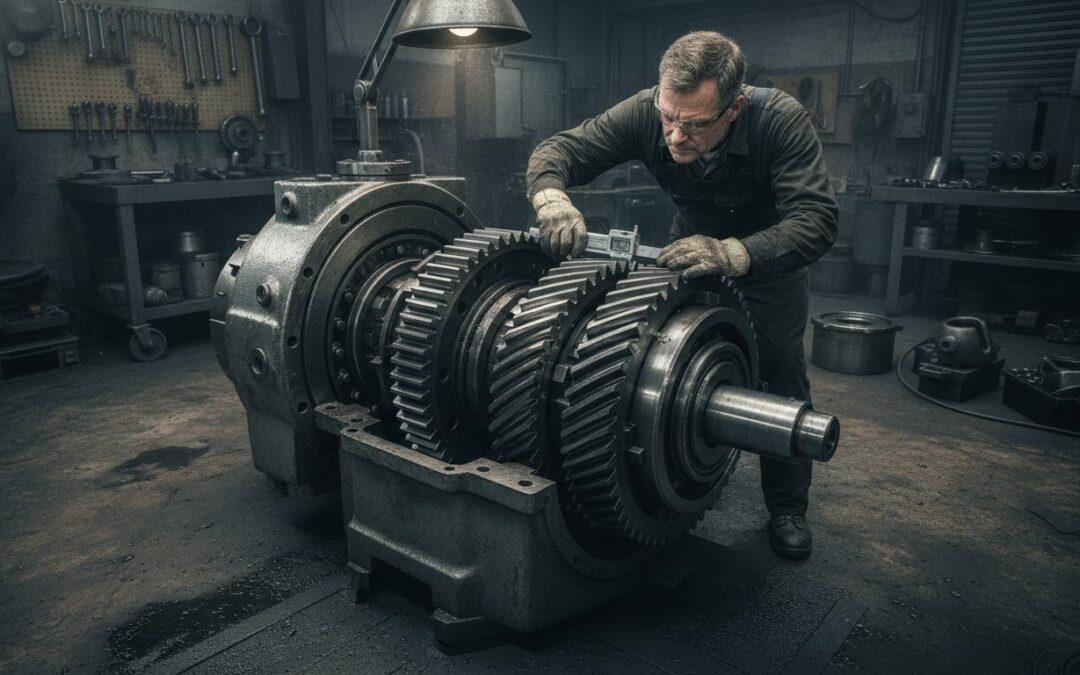
Scrapping a multi-ton gearbox because of gear pitting or a spun bearing is often an unnecessary hit to your budget that ignores the potential for a full restoration to OEM standards. When a critical drive goes down, the prospect of a six-month lead time for a new unit is rarely an option for a facility running at capacity. Professional repair services for large industrial gearboxes provide a technical alternative that restores mechanical integrity while significantly reducing the operational downtime that kills your quarterly production targets. It isn’t just about getting the shafts turning again; it’s about ensuring the unit doesn’t end up back on the shop floor in another six months.
You’ve probably seen your share of “quick fixes” that didn’t hold up under load, and you know that true reliability requires a more disciplined engineering approach. This guide explores how precision restoration and rigorous failure analysis can extend the lifespan of your most critical assets. We’ll look at how the June 18, 2026, ISO gear standard updates impact load calculations and surface durability requirements. By the end of this article, you’ll understand how to validate a rebuild and implement strategies that reduce your Mean Time Between Failures (MTBF) for long-term stability.
Key Takeaways
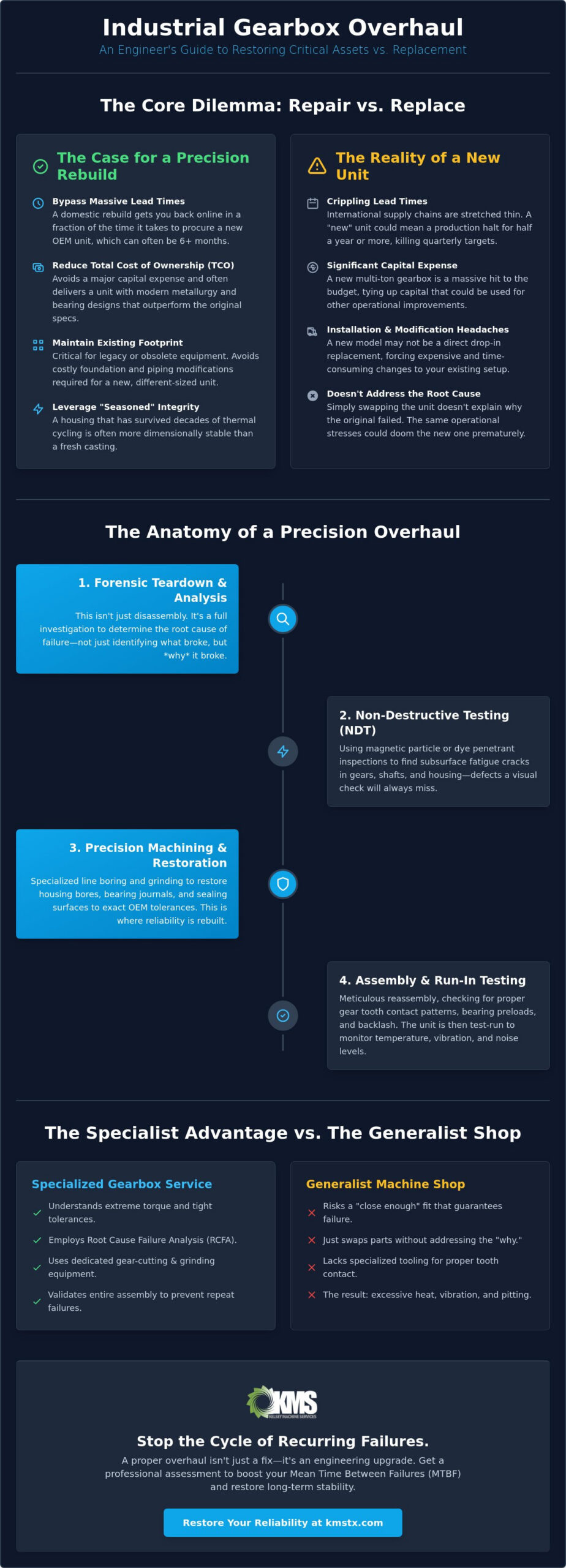
- Evaluate the cost-benefit of refurbishing existing units to bypass the massive lead times and capital expenses often associated with new OEM procurement.
- Walk through the technical steps of a precision overhaul, from multi-point visual inspections to Non-Destructive Testing (NDT) for subsurface cracks.
- See why professional repair services for large industrial gearboxes rely on Root Cause Failure Analysis (RCFA) to stop recurrent issues like pitting and abrasive wear.
- Learn how to implement proactive monitoring schedules that use vibration analysis and thermography to boost your Mean Time Between Failures (MTBF).
- Discover how modern engineering can bring older or obsolete gearboxes back to original specifications while improving overall mechanical reliability.
Beyond the Breakdown: The Value of Specialized Industrial Gearbox Repair Services
The decision between buying a new unit or fixing what you have isn’t just about the invoice. It’s about the clock. In heavy industry, a gearbox failure on a conveyor or a mill isn’t just a part cost; it’s a production hemorrhage. Utilizing specialized repair services for large industrial gearboxes allows you to bypass the long lead times that currently plague international supply chains. While a new OEM unit might be stuck in transit for months, a domestic restoration can often get your facility back to capacity in a fraction of the time.
Beyond the immediate time savings, there’s a strong case for the mechanical integrity of a restored unit. A housing that has survived decades of thermal cycling and load is often more stable than a fresh casting. By focusing on precision engineering rather than simple part replacement, you’re essentially “seasoning” the equipment for another lifecycle. This approach also supports broader sustainability goals by reducing the energy and raw materials required to forge new housings and cast large components from scratch.
To better understand the complexity involved in these systems, watch this helpful video showing a complete gearbox restoration:
When to Choose Repair Over Replacement
You need to start with a cold, hard look at the structural integrity of the gearbox housing. If the main casing is sound and hasn’t suffered catastrophic stress fractures, it’s almost always a candidate for a rebuild. This is especially true for legacy or obsolete equipment where the original manufacturer is no longer in business. In these cases, repair services for large industrial gearboxes are the only way to maintain your current footprint without expensive foundation and piping modifications. When calculating your Total Cost of Ownership (TCO), remember that a refurbished unit, built with modern metallurgy and better bearing designs, often outperforms the original specs. Understanding mechanical transmission fundamentals is key to recognizing when a housing can be salvaged through line boring and sleeve installation rather than being scrapped.
The Risks of Generalist Machine Shops
A generalist shop might be great for turning a shaft or milling a simple bracket, but large industrial gearboxes are different animals. They operate under extreme torque and heavy loads that require incredibly tight tolerances. Generalist shops often lack the dedicated gear-cutting and grinding equipment necessary to ensure proper tooth contact patterns. Without these specialized tools, you risk a “close enough” fit that leads to excessive heat, vibration, and eventual gear pitting. A specialized shop understands that every micron matters in high-load applications. They don’t just swap parts; they validate the entire assembly to ensure it won’t end up back on the shop floor in another six months.
The Technical Anatomy of a Precision Gearbox Overhaul
A high-quality restoration is far more than a “clean and green” paint job. When you’re dealing with repair services for large industrial gearboxes, the process has to be clinical. It starts with a comprehensive teardown that treats the unit like a forensic investigation. We aren’t just looking for broken teeth; we’re looking for why they broke in the first place. This involves Non-Destructive Testing (NDT), such as magnetic particle or dye penetrant inspections, to find the subsurface cracks that a visual check will miss every time. If you miss a fatigue crack in a housing bore or a shaft journal, you’re just building a ticking time bomb.
Precision machining is the backbone of this phase. We often see housing bores that have been hammered out of round or shafts with significant fretting. Restoring these to OEM tolerances requires specialized line boring and grinding equipment. This is also where precision dynamic balancing becomes a dealbreaker. Many shops skip this, but at high RPMs, even a tiny imbalance in a large gear set creates centrifugal forces that destroy bearings. Integrating balancing into the gearbox rebuild is how you ensure the unit runs smooth from day one.
Step 1: Forensic Disassembly and Cleaning
The first step is documenting the “as-found” condition. We look at oil samples, check for metal shavings, and measure backlash before anything is even washed. Cleaning is done with specialized methods that don’t strip away the wear patterns. These patterns tell a story about misalignment or lubrication failure. Every clearance and tolerance is measured against the original manufacturer’s specs to determine exactly where the system drifted out of compliance.
Step 2: Component Restoration and Manufacturing
Step 3: Final Assembly and Load Testing
Assembly is where the math meets the metal. We verify gear tooth contact patterns using bluing compounds to ensure the load is distributed across the entire face of the tooth. Backlash is set to the micron. Once the unit is sealed, we perform a spin test. We’re monitoring for vibration, checking lubrication flow, and watching thermal stability. If you’re dealing with a problematic unit, it’s worth having a professional shop evaluate your gearbox health before the next scheduled outage.
Engineering vs. Replacement: Why Failure Analysis Trumps Part Swapping
If you just swap out a broken gear without asking why it failed, you’re just scheduling your next breakdown. It’s a common trap in high-pressure environments where the focus is solely on getting the shafts turning again. Professional repair services for large industrial gearboxes distinguish themselves by performing a Root Cause Failure Analysis (RCFA) as a standard part of the process. We examine the gear teeth under high magnification to identify specific failure modes like pitting, spalling, or abrasive wear. Each of these signatures points to a distinct issue. Pitting might suggest a lubrication film breakdown, while spalling often indicates subsurface fatigue or material defects that were present from the factory.
Environmental factors often play a bigger role in equipment life than many operators realize. Ambient temperature spikes or heavy particulate contamination can cook the oil or turn it into a grinding paste that eats through case-hardened surfaces. By analyzing diagnostic data from the failed unit, we can recommend system-wide improvements. Maybe your cooling system is undersized for a recent production ramp-up, or your filtration isn’t catching the fine abrasive dust in your facility. Solving these issues is the only way to get the full value out of a restoration and prevent the same unit from returning to the shop in six months.
Metallurgical Investigation and Lubrication Analysis
Sometimes the problem isn’t the repair; it’s the original application. We analyze metal fatigue patterns to determine if the gearbox was undersized for the actual torque demands of your process. If we see signs of micro-pitting across the entire gear set, it’s a clear red flag. Oil analysis reports are also critical tools. They identify specific contamination sources, like a failing seal allowing moisture ingress or an internal component shedding material. This level of detail allows us to optimize gear geometry or select superior alloys during the manufacturing phase of the rebuild. It’s also where the June 18, 2026, ISO gear standards update comes into play. These new standards change how we interpret surface durability and load calculation, requiring a tighter alignment between material records and final performance claims.
Preventing Recurrent Failures
The ultimate goal is to return a unit that is more resilient than it was on day one. This often involves modifying component designs to handle increased operational demands that the original OEM didn’t anticipate. We might upgrade the sealing system to a labyrinth design for a washdown environment or change the bearing configuration to better handle axial thrust. Integrating these improvements into your broader rotating equipment maintenance strategy shifts your team from reactive fire-fighting to proactive reliability. When you address the root cause, you aren’t just fixing a machine; you’re protecting your facility’s bottom line.
Maximizing MTBF: Proactive Maintenance and Emergency Protocols
High-reliability operations don’t happen by accident. If you have already utilized professional repair services for large industrial gearboxes, you want that investment to last as long as possible. Proactive maintenance is about catching the “whisper” before the “scream.” A rigorous vibration monitoring schedule can identify gear mesh issues or bearing cage damage long before a technician hears a change in the machine’s pitch. Pairing this with regular infrared thermography allows your team to spot localized heat buildup that usually signals a failing lubrication film or a misaligned shaft. Catching these thermal signatures early prevents the localized tempering that ruins gear hardness.
Lubrication management is the simplest way to protect your gears, yet it is often the most neglected. It isn’t just about topping off the reservoir; you need consistent filtration to remove micro-abrasives that act like liquid sandpaper on your gear teeth. Training your on-site team to recognize early warning signs, like a slight change in oil color or a new rhythmic vibration, can save your facility hundreds of thousands in catastrophic repair costs. When your crew knows what “normal” looks and sounds like, they become your most effective diagnostic tool.
Predictive vs. Reactive Maintenance
Predictive maintenance isn’t just a buzzword; it’s a data-driven strategy that yields real results. Industry reports indicate that integrating sensors to monitor vibration and temperature can lower unscheduled downtime by 20-25%. Ultrasonic testing is another heavy hitter here. It detects the high-frequency sounds of early bearing failure that standard vibration sensors might miss in a noisy shop environment. Trend analysis allows you to schedule a shop refurbishment during a planned outage rather than waiting for a catastrophic crash that stops production. The cost-benefit is clear: a planned rebuild is always cheaper than an emergency rescue.
24/7 Emergency Support Strategies
Even with the best maintenance, things can go wrong. You need a tiered response plan for emergency machine repair to minimize the impact on your production schedule. This involves having a partner who can mobilize field technicians for on-site troubleshooting immediately. The logistics of rapid teardown and rush gear manufacturing are what keep a bad situation from becoming a total disaster. When an unplanned outage hits, the goal is to stabilize the equipment and get a clear timeline for the restoration within hours. If you’re seeing signs of distress in your drive systems, it’s time to consult with a gearbox specialist to assess your current maintenance schedule before the next failure occurs.
Restoring Industrial Reliability with Kelsey Machine Services
Kelsey Machine Services has spent four decades refining the process of industrial gearbox repair, moving far beyond basic maintenance into the territory of precision engineering. We understand that when a high-torque drive fails, you don’t just need a mechanic; you need a partner who understands the metallurgical and mechanical stresses specific to your industry. Our commitment is simple: we restore every unit to OEM specifications or better. By integrating custom machining and dynamic balancing under one roof, we eliminate the communication gaps that often occur when multiple vendors are involved in a single rebuild.
Technical transparency is the cornerstone of our national service capabilities. We don’t hide behind corporate jargon or vague status updates. Instead, we provide detailed documentation and forensic evidence for every repair we undertake. This level of clarity ensures that your maintenance team has the data they need to justify the spend and plan for future reliability. When you choose our repair services for large industrial gearboxes, you’re getting a solution backed by forty years of field-tested experience and shop floor expertise.
Why Industry Veterans Trust KMS
Experienced plant managers and engineers know that the quality of a repair is only as good as the experts behind it. At KMS, you get direct access to engineering experts who have spent years working on the specific architectures of brands like Falk, Lufkin, and Flender. You aren’t talking to a sales rep who is reading from a script; you’re talking to a professional who understands backlash settings, tooth contact patterns, and thermal expansion coefficients. This deep technical bench is why industry veterans trust us with their most critical rotating assets. We focus on the details that matter to those who live and breathe industrial operations every day.
Partnering for Long-Term Asset Health
We don’t believe in a one-size-fits-all approach to restoration. Your operational load, environmental conditions, and production cycles are unique, so your repair plan should be too. We work with you to develop customized strategies that address the specific failure modes identified during our initial RCFA. This partnership extends beyond the final spin test, as we provide ongoing technical support and maintenance consultation to help you maintain peak performance. If you’re ready to move beyond reactive fixes and secure your facility’s future, contact Kelsey Machine Services for a technical gearbox evaluation and see how a precision-engineered restoration can stabilize your production.
Securing Your Facility’s Future Through Technical Restoration
Restoring a critical drive isn’t just about surviving the current outage; it’s about engineering out the flaws that caused the failure in the first place. By prioritizing root cause analysis and precision dynamic balancing, you’re investing in a unit that will likely outlast its original factory lifespan. This technical approach shifts your facility from a cycle of recurrent breakdowns to a state of predictable reliability. You’ve seen how precision machining and proactive monitoring can change the game for your MTBF.
When you choose specialized repair services for large industrial gearboxes, you’re gaining access to over 40 years of rotating equipment expertise. Kelsey Machine Services provides full in-house machining and balancing capabilities, backed by 24/7 emergency field service response for those critical moments when downtime isn’t an option. It’s about having the right data and the right experts in your corner to protect your bottom line. Don’t let a legacy unit become a liability when it could be your most reliable asset.
Ready to assess the health of your critical drives? Request a Technical Consultation for Your Gearbox Repair and get a clear path toward long-term mechanical integrity. Your equipment is the backbone of your operation; treat it with the precision it deserves.
Frequently Asked Questions
How long does a typical large industrial gearbox repair take?
Repair timelines depend entirely on the unit’s condition and the availability of critical components. A standard bearing and seal replacement might take 5 to 10 days, while a full restoration requiring custom gear manufacturing can take 4 to 6 weeks. This is still significantly faster than the current lead times for new OEM units, which often stretch into several months due to global supply chain constraints.
Can you repair gearboxes from brands that are no longer in business?
We can restore gearboxes from any manufacturer, including legacy brands that have been out of business for decades. Since we don’t rely on OEM supply chains, we use in-house custom machining to manufacture replacement components that meet or exceed the original specifications. This capability allows us to keep older equipment running without requiring expensive foundation modifications for a new model.
What is the difference between a gearbox “rebuild” and a “refurbishment”?
A refurbishment usually involves a thorough cleaning, seal replacement, and new bearings to extend the unit’s current service life. In contrast, a rebuild is a comprehensive overhaul where every component is inspected, shafts are machined, and gears are replaced or restored to original tolerances. Rebuilds typically include dynamic balancing to ensure the unit meets original performance standards.
Do you provide on-site gearbox inspections and minor repairs?
How do you ensure the gears you manufacture meet OEM standards?
Every gear we manufacture undergoes rigorous metallurgical testing and precision machining to ensure it matches the original design intent. We utilize advanced gear-cutting equipment and adhere to the latest ISO gear standards released in June 2026. This ensures that tooth geometry, surface hardness, and load-carrying capacity are verified before the component is ever installed in the housing.
What kind of warranty is provided on industrial gearbox repairs?
Kelsey Machine Services provides a 24-month warranty on rebuilt equipment, covering both parts and workmanship. This warranty reflects our confidence in the precision engineering and failure analysis we apply to every project. It’s a standard we maintain to give plant managers peace of mind that their restored assets will perform reliably under heavy operational loads.
Can you reverse engineer a gearbox without the original blueprints?
Blueprints aren’t necessary for high-quality repair services for large industrial gearboxes. We use coordinate measuring machines (CMM) and material analysis to map the exact geometry and alloy composition of your existing components. This data allows us to create accurate manufacturing drawings and produce replacement parts that fit perfectly within the original housing bores.
What are the most common signs that a gearbox is about to fail?
Keep a close watch for increased operating temperatures, new rhythmic knocking sounds, or elevated vibration levels. These are often the first indicators of bearing fatigue or gear tooth pitting. Finding metal shavings or “glitter” during a routine oil change is a critical red flag that suggests internal components are actively shedding material and require immediate technical evaluation.